

STK
Mission design and orbital modeling
Matt Halferty — CEO and Founder, Black Night Space LLC
STK Access for the project
Senior engineer, 1 day/week
Delivered scenario file you keep
Engineering hours included
ODTK access for the project
Built ingest pipeline
Ops team training included
Engineering hours included
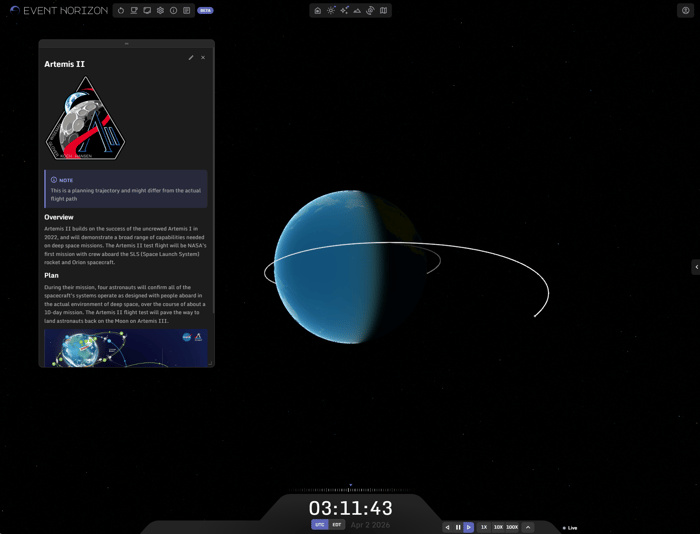
Event Horizon deployment
2 custom mission scenes
30 days of post-launch tuning
Engineering hours included
Do you work with pre-revenue startups?
Yes — pre-revenue and pre-seed teams are some of our best customers. We won't push a six-figure stack on a five-person team, and we won't gate access to our engineering team behind a license sale. At pre-seed, that often looks like an hour with one of our aerospace engineers to sanity-check your tooling plan, a small STK quote sized for one or two seats, or pointing you toward the alternative that's actually right for your stage.
Can we use Ansys tools without buying perpetual licenses?
Yes. Ansys offers term licenses (annual or multi-year) for every product in the Digital Mission Engineering suite, and that's what we recommend for early-stage teams. Perpetual licenses are an option but rarely the right choice for a startup whose stack will evolve over the next 18 months. We can also structure short-term licensing tied to specific engagements — for example, a 90-day STK license bundled with a Mission Design Kickoff Sprint. The decision is about runway flexibility, not capability access.
Is Event Horizon ready for production?
Production for the use cases it was built for. Sharing scenes with investors, embedding visualizations in customer portals, and powering ops-center status displays. We're still expanding the capability surface (more data formats, more deployment options), and we work directly with early customers to scope what production-ready means for their specific deployment. If you have a specific workflow in mind, the most honest answer comes from a 30-minute conversation, we'll tell you whether it's ready today or which release it lands in.
How fast can we have STK in our hands?
For a standard single-seat order, typically 2 to 5 business days from signed quote to license file. Production licensing depends on the configuration and whether you need add-on modules. A clean STK base license usually closes in a day or two; complex multi-seat deployments with specific modules take longer. We can run an evaluation license if you want hands-on time quickly before committing to a longer-term license.
Can your engineers sign NDAs and work hands-on inside our environment?
Yes. Standard mutual NDAs are routine. We'll sign yours or send ours, usually within the same business day. For deeper engagements involving controlled data or proprietary IP, our Blacknight Federal enclave (FedRAMP-aligned, CMMC-compliant) lets us operate inside a secured environment. Our engineers are US-based aerospace professionals; many have held federal clearances. We've worked inside primes, NASA centers, and DoW ops cells, so the operating model is familiar to us.
What does a typical engagement actually cost
It depends on scope, but the honest ranges: an Engineering Sprint (4 to 8 weeks, fixed scope) is typically mid five figures to low six figures. A single STK seat with one module runs low five figures annually; ODTK is similar. Event Horizon for a startup deployment starts in the four figures. A full Series A stack — STK, ODTK, Event Horizon, plus engineering retainer — typically lands in the low six figures annually. We'll quote real numbers in a 30-minute call once we understand your mission.